What If Your Smart Speaker Worked for You?
Most smart speakers follow the same formula. Buy the hardware, connect it to a cloud service, and trust a large company to handle the rest. The arrangement is convenient, but it also means much of the device's functionality depends on infrastructure you don't control.
That's one reason Home Assistant has gained such a large following. Instead of sending everything through someone else's servers, it allows users to build a smart home around software running on their own hardware.
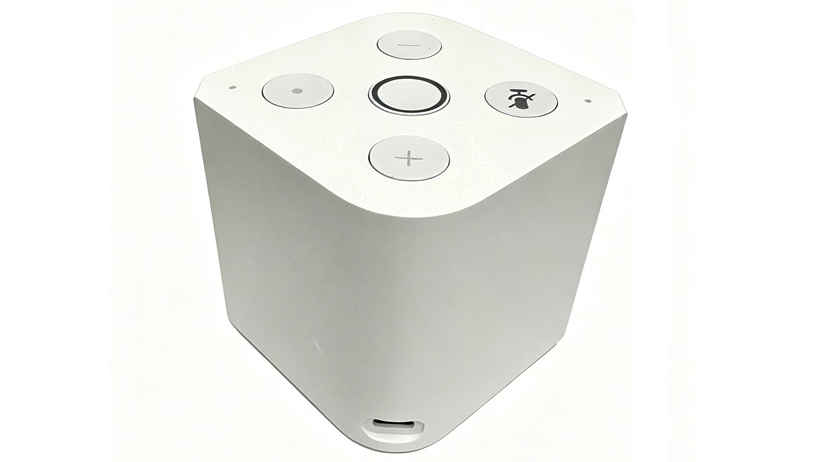
Now Pine64 is offering a speaker designed with that approach in mind. The company has started taking orders for the PineVoice smart speaker, a device built around Home Assistant and powered by a RISC-V processor.
Built Around Open Hardware Principles
The PineVoice traces its origins back more than two years, when Pine64 first introduced the concept as a hacker-friendly alternative to products such as the Amazon Echo and Google Home.
Inside the speaker is a Bouffalo Lab BL606P processor featuring two RISC-V CPU cores. One core runs at up to 480 MHz, while the second operates at up to 320 MHz. The system also includes 16 MB of PSRAM, 16 MB of onboard flash storage, Wi-Fi, Bluetooth, dual microphones, and support for Zigbee through an optional add-on dongle.
Physical controls include volume buttons, a start/stop button, and a dedicated microphone mute button with an indicator LED.
For privacy-conscious users, that hardware mute switch may be one of the more attractive features. Rather than relying solely on software settings, it provides a direct way to disable microphone input.
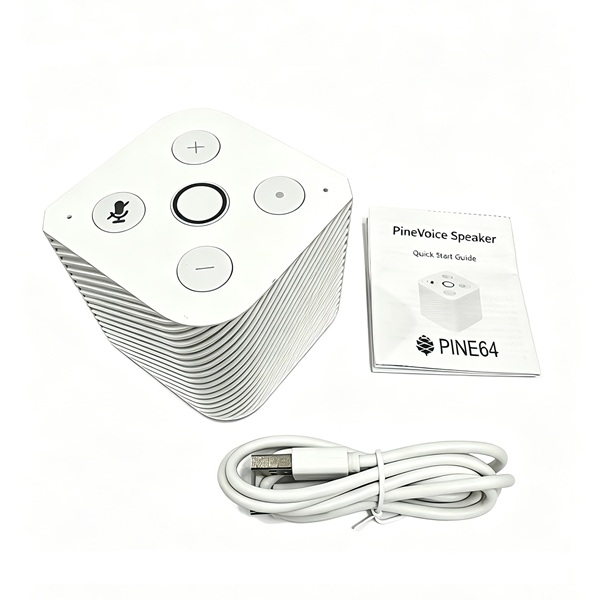
Designed for Home Assistant
Unlike many commercial smart speakers, PineVoice is intended to work with Home Assistant from the start.
The speaker can function as an interface for a locally hosted Home Assistant installation running on hardware such as a Raspberry Pi, mini PC, or virtual machine. Cloud connectivity is available through Home Assistant's optional services, but it is not required.
That distinction matters. If your internet connection goes down, or if a company decides to discontinue a service, a locally managed system can continue operating.
The default firmware currently supports Wyoming Satellite, although Home Assistant's newer ESPHome-based approach is becoming the preferred option for many users.
More Dev Kit Than Finished Product
Pine64 is being fairly candid about the current state of the device.
The company describes PineVoice as an early-stage platform and notes that some features remain a work in progress. Wake word detection is supported, but performance can vary and may not work equally well for all users. Bluetooth speaker functionality is also planned but not yet available.
That means buyers should approach PineVoice as a development platform rather than a polished consumer product.
For many members of the Home Assistant community, that probably won't be a dealbreaker.
Another Option for Tinkerers
At $50, PineVoice occupies an interesting position. It costs less than many premium smart speakers while offering a level of openness that is increasingly difficult to find in consumer electronics.
The hardware is documented, the software ecosystem is community-driven, and the platform encourages experimentation rather than locking users into a single vendor's services.
For anyone already running Home Assistant, PineVoice offers another way to interact with their smart home. For everyone else, it may serve as an introduction to a different approach to connected devices—one where the user remains in control.