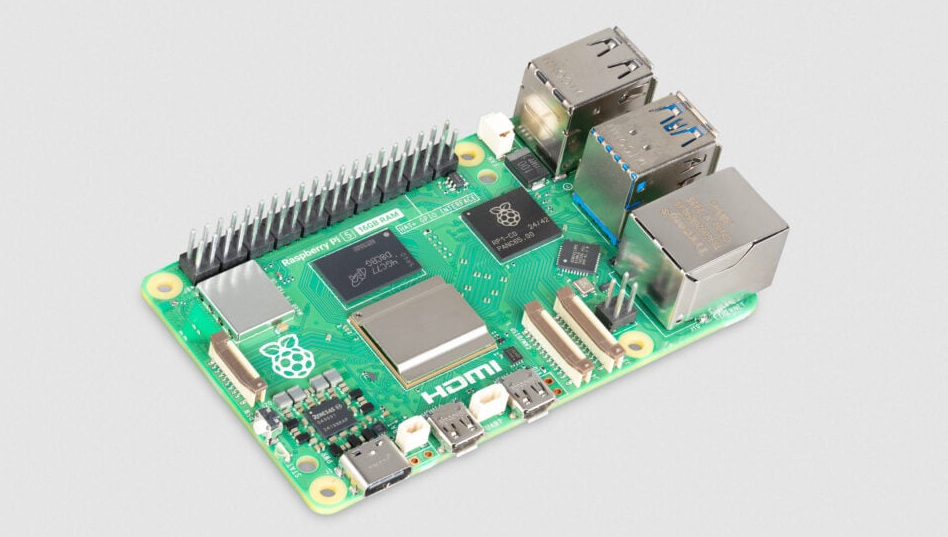
If you've experimented with AI on a Raspberry Pi, you've probably run into the same limitation that everyone else has. While the Raspberry Pi 5 is considerably faster than its predecessors, running modern machine learning models can still be a challenge. Many projects end up relying on dedicated accelerators such as the Hailo-8L or Google Coral to achieve useful performance.
But what if the hardware needed for AI acceleration was already sitting on the board?
Turning the GPU Into an AI Engine
Researchers from the University of Glasgow and the University of Edinburgh have been exploring exactly that possibility. In a recently published paper, they describe a system called VideoCore Neural Engine (VCNE) that uses the Raspberry Pi 5's built-in VideoCore VII graphics processor to accelerate neural network workloads.
For most Raspberry Pi users, the GPU exists primarily to drive displays, render graphics, and handle video-related tasks. Yet modern graphics processors are built around large numbers of parallel processing units, making them well suited for the mathematical operations used in machine learning. The challenge is finding an efficient way to take advantage of that hardware.
VCNE was developed for exactly that reason. The software includes a compiler and runtime environment that converts neural network operations into workloads that can be executed on the Raspberry Pi 5's GPU. Rather than performing these calculations on the CPU, they are distributed across the GPU's parallel processing resources.
Up to 30× Faster Performance
According to the researchers, the results were fairly impressive. During testing, the GPU-powered implementation delivered performance improvements ranging from roughly four times faster than equivalent CPU-based NumPy implementations to more than thirty times faster in some workloads. The paper also reports notable gains in energy efficiency, an important consideration for robotics, battery-powered systems, and edge computing applications.
The work focused on common building blocks used throughout modern machine learning models, including matrix multiplication, convolution, pooling, and activation functions. These operations form the foundation of many AI applications, from image classification and object detection to sensor analysis and autonomous systems.
Why Makers Should Care
The timing is particularly interesting given how frequently the Raspberry Pi is being used for AI projects. Over the past few years, we've seen makers build everything from smart cameras and autonomous robots to voice assistants and environmental monitoring systems powered by machine learning. In many of those projects, performance is often constrained by the hardware available.
Being able to extract additional AI performance from a standard Raspberry Pi 5 could make experimentation more accessible, especially for students, educators, and hobbyists who may not want to purchase additional accelerator hardware for every project.
Still Early, But Worth Watching
The researchers are careful to note that VCNE is still a research project rather than a finished product intended for everyday users. There is still work to be done before it becomes part of the broader Raspberry Pi software ecosystem. Even so, the project highlights something many makers have suspected for a while: there may be considerably more untapped potential hiding inside the Raspberry Pi 5 than most people realize.
For anyone interested in embedded AI, that possibility alone makes this project worth keeping an eye on.